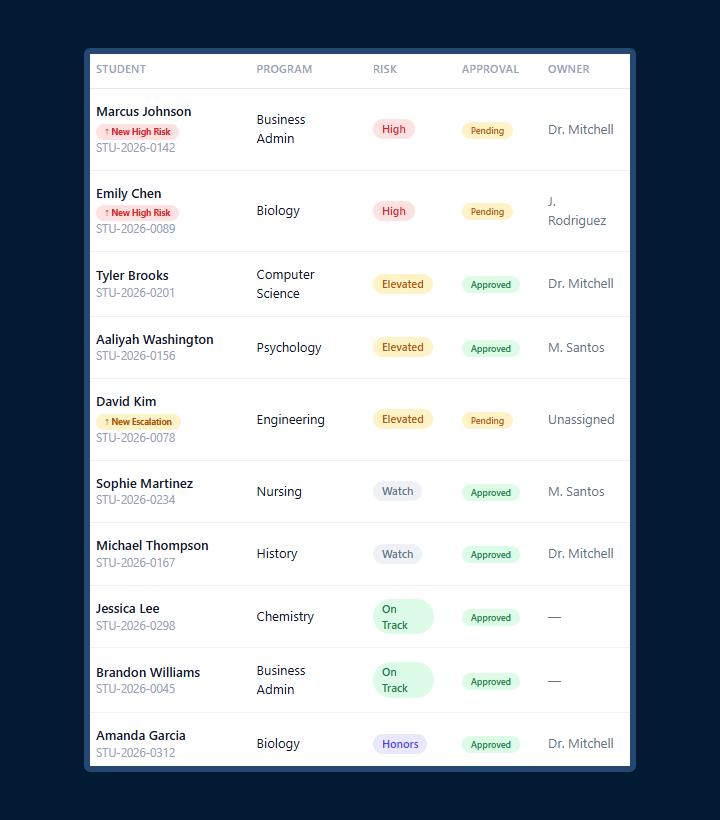
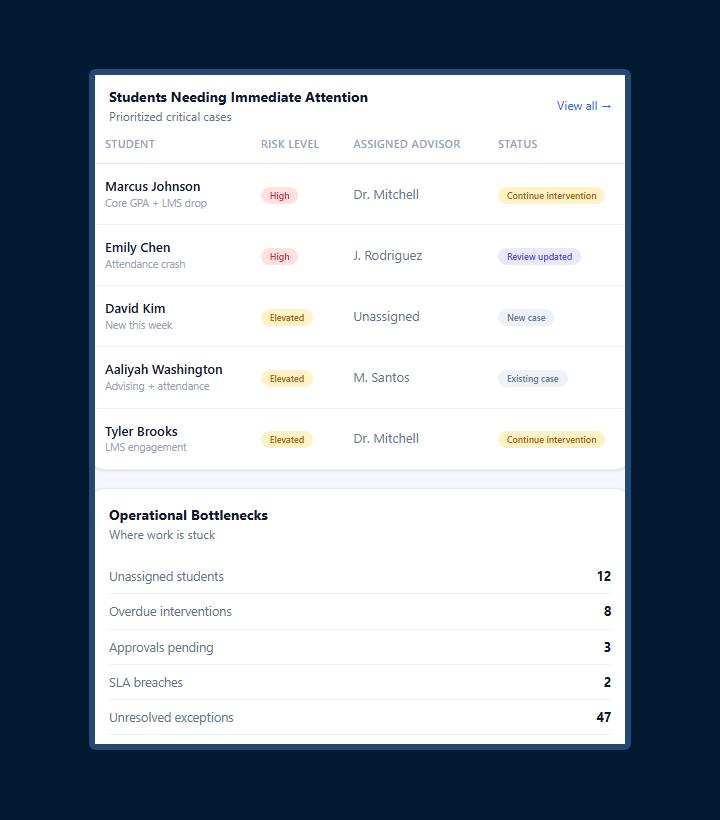
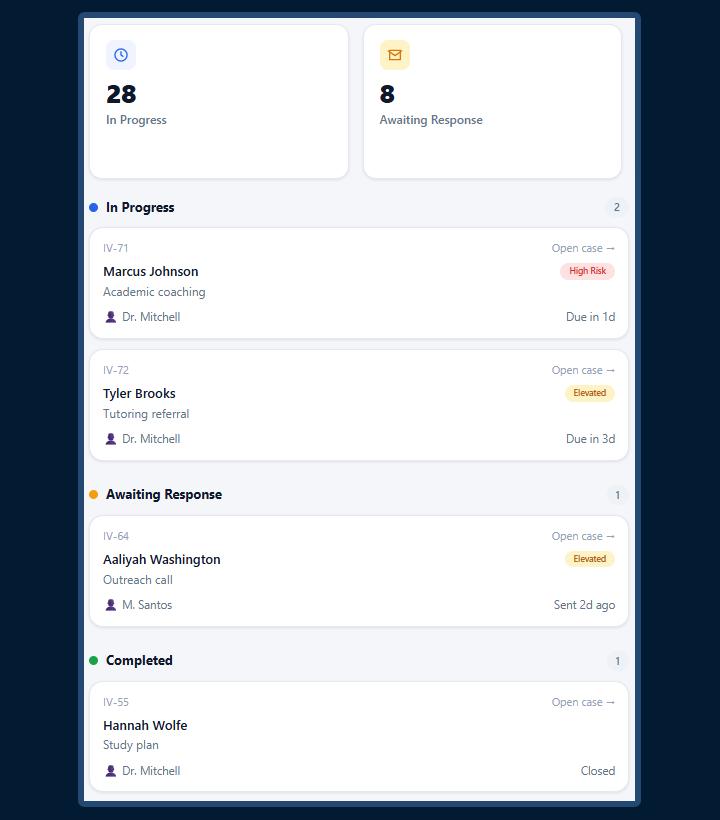
Retain by Decisions turns fragmented risk signals into assigned, time-bound interventions, with human approval, SLA-based escalation, and a complete audit trail. Built for institutions that want students to succeed while protecting their financial stability.

Retention connects two goals that are usually tracked separately: helping students reach graduation, and protecting the tuition revenue and budget stability that depends on them staying enrolled.

More signals, earlier warnings, and a governed way to turn research into action, so at risk students get help before they disengage.

Every percentage point of retention is protected tuition revenue. Retain turns attrition risk into a forecastable, auditable financial metric, not just a student services concern.
Source: National Student Clearinghouse Research Center, Persistence and Retention Report
Student retention isn't only a data problem, it's an operations problem. Institutions are sitting on the signals they need, but disconnected systems and processes keep insight from reaching students in time.

New risk signals appear across transcripts, SIS, LMS, advising, aid, and degree audit systems every day.

Teams manually review, standardize, and interpret student records before they can identify risk consistently.
See how Retain, built on the Decisions platform, turns scattered student data into faster, more consistent retention decisions.

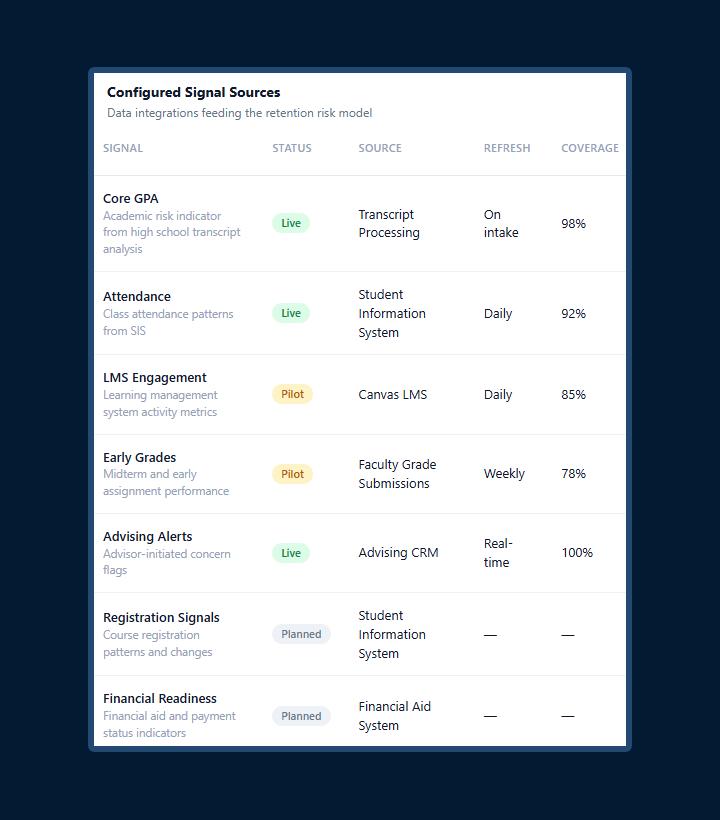
Connect SIS, LMS, advising, financial aid, attendance, degree audit, and other sources to create a flexible, unified view of each student’s risk signals.


Students rarely leave because of one grade, one missed class, or one isolated event. Risk develops across academic progress, engagement, financial pressure, well-being, and a student’s sense of belonging.
of fall 2024 college starters were still enrolled at their starting institution one year later.
of currently enrolled students considered stopping their coursework within the previous six months.
of students considering leaving cited emotional stress, while 41% cited personal mental health reasons.
It’s three weeks before the semester starts. Your team is working from a spreadsheet stitched together from the registrar’s office, financial aid, and last year’s advising notes, and it’s already out of date. One student’s aid status has changed. Another has stopped completing onboarding steps. A third is showing an early pattern your research team has linked to withdrawal. Each signal exists, but no one sees the full picture.
Without proactive detection and notification, staff have to find those students by hand. By the time risk is confirmed, the intervention window that can change the outcome has already started closing. Multiply that across every cohort and term, and the gap doesn’t just cost staff time; it costs enrollment, tuition revenue, and your ability to show the board that retention efforts are working.
Retain replaces the spreadsheet-and-guesswork cycle with a governed retention operation that detects risk proactively, assigns action, and tracks follow-through every term.
Built to connect the full retention cycle: more signals, earlier detection, coordinated action, accountability, analysis, and simulation.
Join our October webinar to see how institutions can connect data, identify risk earlier, and orchestrate the interventions that help students stay on track.
Retain connects signals from SIS, LMS, advising, financial aid, attendance, degree audit, onboarding, and other institutional systems, unifying them into a flexible student risk record.
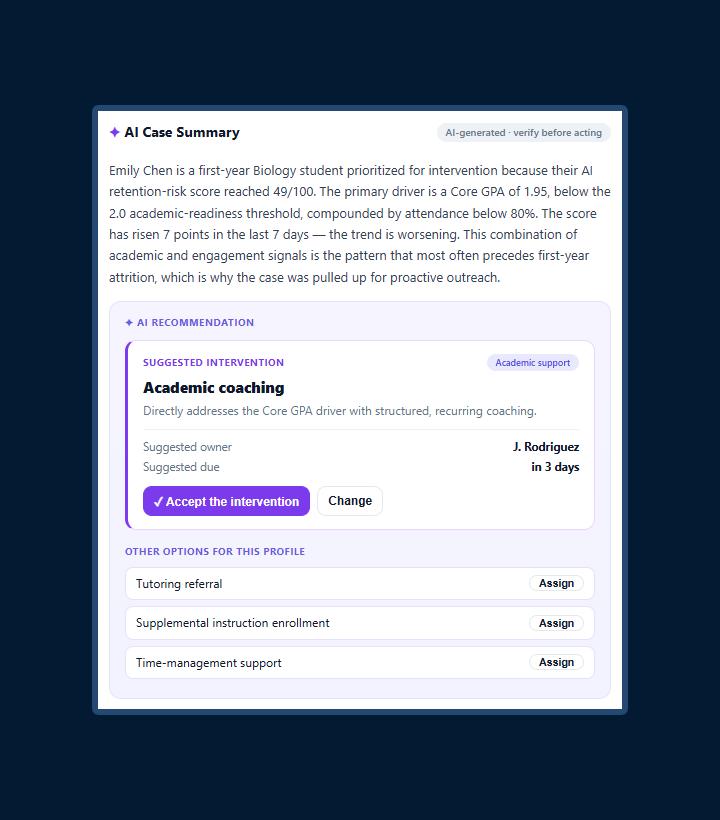
Retain continuously evaluates institution-selected signals using configurable rules and AI-assisted models. Explainable triggers show why a student was prioritized, so staff can focus on reviewing and acting instead of assembling data by hand.

Talk to a specialist to see how Retain converts student-risk signals into approved, assigned, and auditable intervention workflows, protecting both student outcomes and the tuition revenue tied to every retained student.

Institutions can't fully leverage AI because data is fragmented and obfuscated for compliance, so research findings rarely turn into live and timely intervention logic.
The signals are already there. The challenge is bringing them together early enough to act. Retain connects institutionally available signals across systems, proactively identifies changes in student risk, and turns those insights into assigned, trackable interventions before the opportunity to help begins to close.

Yes. Institutions can place human review and approval at the points where judgment matters most. Retain preserves the supporting signals, decision, owner, and action history so oversight does not depend on manual handoffs.
Yes. The Advanced Integration Layer provides bidirectional connections to SIS, LMS, advising, financial aid, and other institutional systems, so siloed signals feed one consistent risk record and actions can move back into the systems teams already use.
Accountability is core to the platform. PII is automatically scrubbed as needed so institutions can apply AI-assisted analysis without exposing sensitive student records, while a full chain-of-custody audit trail documents who reviewed, approved, and acted on each case.