Go beyond connecting systems with API orchestration. Apply business rules, handle exceptions, and track every step of your workflows.

APIs exchange data and trigger actions, but they do not define the full business process on their own. API orchestration coordinates the sequence, rules, and handoffs that determine what happens next.

Business rules live across individual services, scripts, and applications, making them difficult to find, update, and govern.

APIs trigger activity, but they do not coordinate the people, systems, decisions, and exceptions behind real work.
Decisions wraps API calls in workflows and business rules. Sequence actions, route data, handle exceptions, and determine the next step while keeping process logic visible and easier to update.
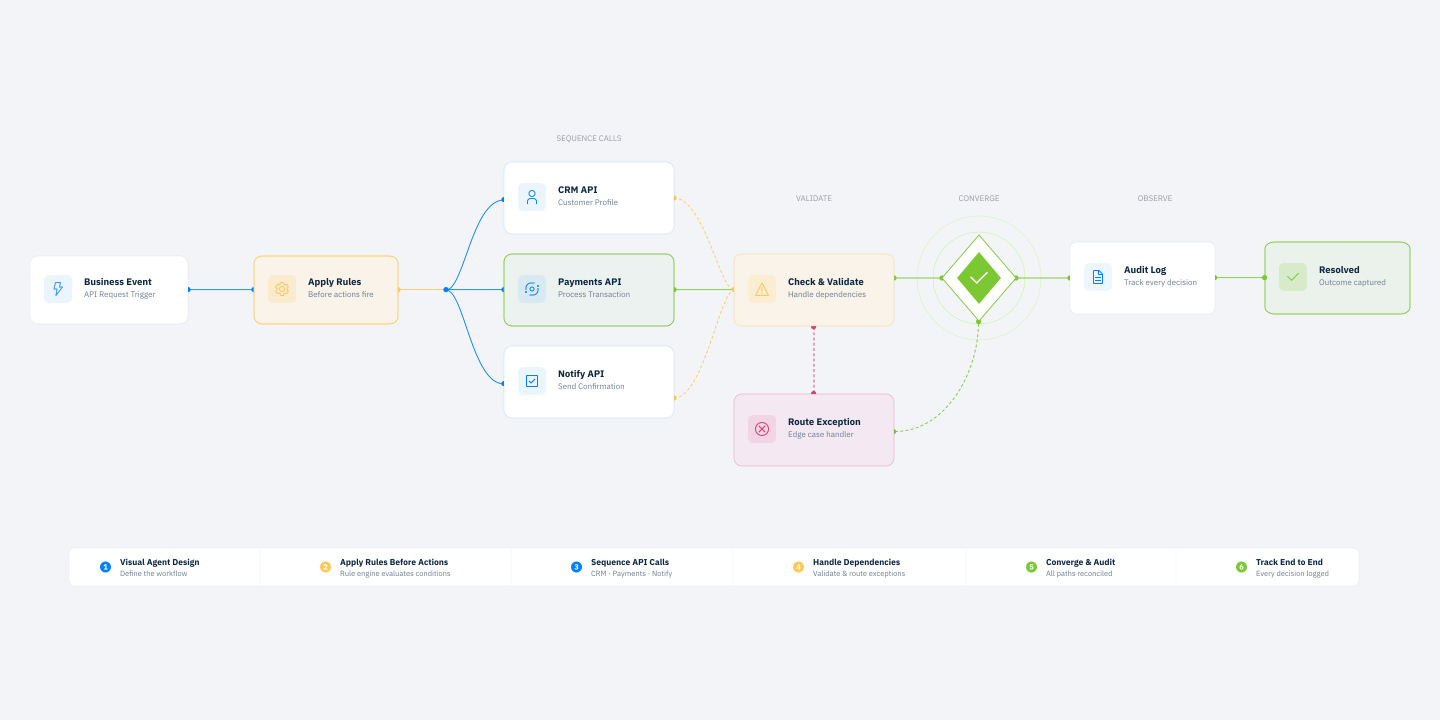
Turn individual API calls into reusable, auditable workflows that support integration automation across systems.

Coordinate calls without manual handoffs.

Every action logged, every rule enforced.

A unified platform designed to run your business—No silos, No handoffs, No guesswork.

Model and execute complex logic with an enterprise rules engine








“I'm really impressed by what the system can do from the technical side. It fits our particular needs well where we have limited IT resources, sensitive data, and complex business and data rules that need to be centralized and integrated with other systems. The fact that it makes forms and API endpoints automatically is a HUGE time and complexity saver.”

API orchestration coordinates API calls, data, and business logic to complete a process. It determines which actions run, in what order, under which conditions, and what happens when an exception occurs.
API orchestration adds process logic to automated integrations. Instead of automating isolated calls, teams can coordinate dependent actions, evaluate responses, and route work across connected systems.

See how Decisions turns connected APIs into coordinated workflows with business rules, governance, and visibility built in.

API activity may be visible in individual systems, while the full process path, decision logic, and outcome remain harder to track.
Change logic without rewriting integrations.

See how systems, APIs, and decisions connect.

Build once, reuse API workflows across teams, systems, and processes.

Route failures, approvals, and edge cases to the right next step automatically.
API orchestration focuses on coordinating API calls. Microservices orchestration coordinates independent services within a broader process, which may also involve events, workflows, and business rules. The approaches overlap when microservices communicate through APIs.
Yes. Decisions can call existing APIs within workflows and expose its flows and rules as APIs. Teams can build orchestration around existing services rather than replacing them.
Business rules determine which APIs run, what conditions apply, and where work goes next. Decisions manages that logic within workflows so teams can review and update it without rewriting each integration.
AI agents use APIs to interact with systems and take actions. Decisions coordinates those actions through workflows, business rules, and audit trails.