Decisions was recognized as a Leader in Everest Group's AI-powered Decision Intelligence Products PEAK Matrix® Assessment.
AI-powered decision intelligence platforms help teams model how decisions are made, simulate the impact of changes, and put decision logic to work in everyday processes.
These platforms combine AI’s ability to interpret information with business rules that enforce policy. Routine decisions can move forward automatically, while exceptions go to the right person for review.
By connecting decisions to the workflows and systems that carry them out, these platforms help teams see what happened, measure the results, and improve how future decisions are made.
AI can analyze a document in seconds, spot patterns across millions of transactions, and recommend the next best action with impressive accuracy.
But generating insights is not the same as delivering outcomes.
A model can flag fraud risk, recommend a loan decision, or suggest how to resolve a customer issue. But before a business acts, it still needs to determine which policies apply, whether the information is complete, and when human approval is required.
As enterprises embed AI into everyday workflows, the challenge organizations now face is ensuring AI recommendations lead to decisions that are consistent, governed, and connected to business outcomes.
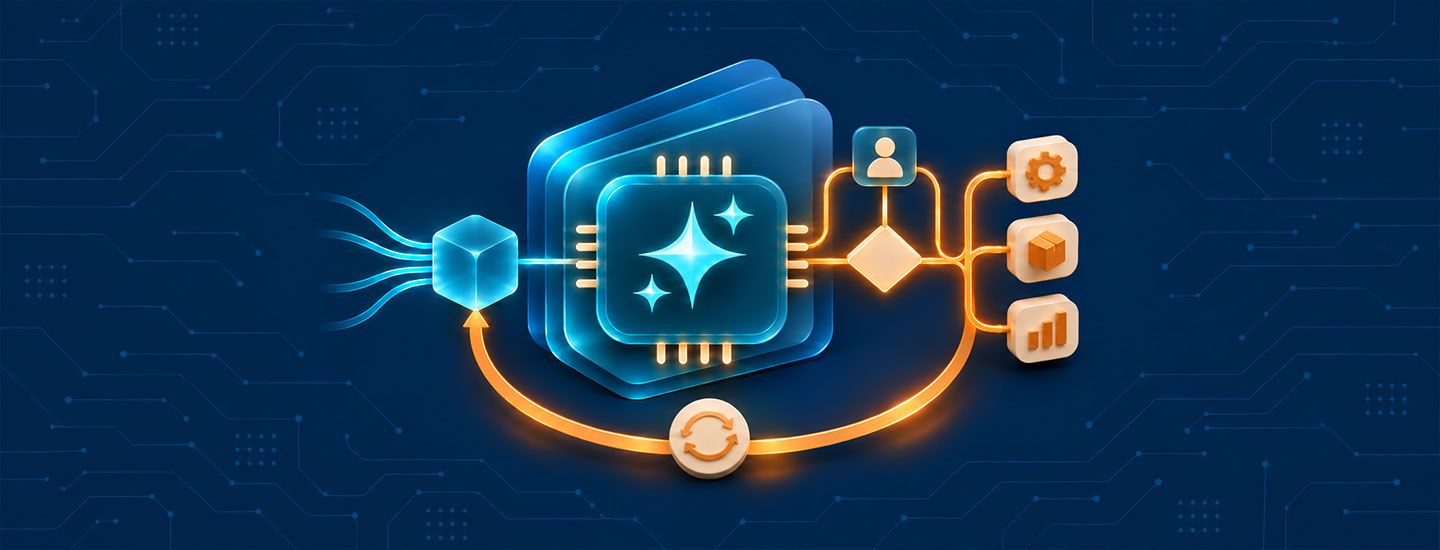
AI-powered decision intelligence addresses this challenge by connecting data, analytics, business rules, and AI to operational decisions. Rather than leaving intelligence in a dashboard, report, or chatbot, it embeds intelligence into the processes that move work forward.
According to Everest Group, the market is evolving beyond traditional analytics toward platforms capable of modeling, optimizing, simulating, and operationalizing decisions across the enterprise. Decisions was recently recognized as a
We believe that recognition reflects a broader shift in enterprise AI. Success is no longer measured by how many predictions a model can make. It is measured by how effectively those predictions are translated into business actions that can be governed, executed, and improved over time.
Achieving that success requires more than intelligent models.
From model performance to decision performance
Much of the discussion around AI focuses on the model.
How accurate is the prediction?
How sophisticated is the algorithm?
How quickly can it generate an answer?
Those questions still matter. But once AI starts influencing customer experiences, financial transactions, claims decisions, or compliance-sensitive processes, model performance alone isn't enough.
Organizations also need to understand:
What information informed the decision?
What policies influenced the outcome?
When should a human be involved?
How can the decision be explained and audited?
What happens when business requirements change?
These are not challenges a better model can solve on its own. They require an architecture that connects AI reasoning with business policy, operational processes, and governance.
As a result, many organizations are discovering that their AI strategy needs more than intelligent models. It needs a framework for governing and operationalizing decisions across people, systems, processes, and AI agents.
AI can review submitted documents, summarize a claimant's account, identify missing information, and estimate risk. A predictive model can flag unusual patterns that deserve additional scrutiny.
These capabilities provide valuable inputs, but they do not determine whether a claim should be approved.
That decision depends on coverage requirements, exclusions, payment thresholds, documentation standards, regulatory policies, and approval authority. And once the decision is made, the work is not finished. Systems must be updated, payments initiated, claimants notified, or cases routed for further review.
The full chain matters.
Interpreting information, applying policy, selecting an action, and executing it are all part of the same decision process. The prediction is only one input into a larger decision-making system.
Viewed holistically, this shifts the conversation from "Where can we add AI?" to "What does this decision need to be faster, more consistent, and more reliable?"
Business rules give adaptive AI an operational boundary
AI and business rules solve different parts of the decision problem.
AI excels when information is variable, incomplete, or requires interpretation. Business rules provide explicit logic for requirements that must be applied consistently, such as eligibility criteria, approval limits, compliance requirements, and escalation policies.
As AI agents become more capable and autonomous, organizations need stronger decision boundaries, not fewer. Consequential business policies should be enforced through executable controls, not left entirely to a model's interpretation of a prompt.
Keeping these responsibilities separate also simplifies change. A policy update should not require teams to revise prompts across multiple agents. Likewise, changing an AI model should not require redefining the business requirements that govern its actions.
The Decisions Rules Engine supports this separation by evaluating AI outputs against configurable business conditions before action is taken. Rules, workflows, and agent actions work together so organizations can combine adaptive reasoning with explicit business controls.
The goal is not to restrict every aspect of AI reasoning. It is to define where flexibility creates value and where consistency is required.
A governed decision must carry through to execution
Policy enforcement is essential, but it is only part of the equation.
A decision creates value when it changes what happens next.
That makes orchestration a critical part of decision intelligence. Context must move with the work as it crosses applications, teams, approval steps, and business systems. A recommendation that cannot reach the right system, recover from a failed handoff, or pause for review remains disconnected from the outcome it was intended to support.
For decision intelligence to work in practice, organizations need three capabilities working together:
Connect reasoning to execution
Decisions connects agents, workflows, enterprise data, and business actions through a unified orchestration layer. It coordinates people, systems, and AI-driven processes while managing routing, approvals, retries, and execution state.
This allows AI-generated recommendations to become part of a governed business process rather than a standalone output that requires manual translation into action.
Put human judgment where it adds value
Human oversight should be aligned with the risk and complexity of the decision.
Reviewing every action limits the value of automation. Automating everything creates unnecessary risk.
Decisions allows organizations to configure approval thresholds, escalation paths, and review requirements directly within workflows. Routine work can proceed automatically, while high-value, ambiguous, or exceptional cases are routed to the appropriate person for review.
Make outcomes visible and improvement deliberate
Decision intelligence also requires visibility into what happened after execution.
Organizations should evaluate AI-supported decisions against business metrics such as cycle time, exception rates, rework, policy adherence, and customer outcomes. Those insights can drive improvements to rules, prompts, models, processes, and approval paths.
Improvement does not require allowing policies to evolve autonomously. Changes can be tested, validated, and reviewed according to their operational impact.
Decisions captures prompts, outputs, rule paths, and actions in a decision history, providing visibility into how decisions were reached and carried out. That record creates a foundation for governance, auditing, and continuous improvement.
The future of enterprise AI is decision-centric
AI is rapidly expanding what's possible. The challenge now is making sure those possibilities translate into actions the business can trust.
Organizations that succeed won't be the ones using AI in the most places. They'll be the ones that can consistently turn intelligence into outcomes while maintaining the governance, accountability, and control their business requires.
Schedule a call with our team to learn how Decisions can help you put AI-powered decision intelligence into practice.
Frequently Asked Questions
What is AI-powered decision intelligence?+−
AI-powered decision intelligence combines data, analytics, AI, and business rules to improve how organizations make and execute decisions. Instead of leaving an AI recommendation in a dashboard or chatbot, it brings that recommendation into a workflow where teams can apply policy, involve people when needed, and act on the outcome.
How is decision intelligence different from predictive analytics?+−
Predictive analytics estimates what might happen. Decision intelligence uses that prediction alongside business rules and other information to determine what should happen next. In insurance claims, for example, a model might flag unusual activity, while coverage rules and approval requirements determine whether the claim can move forward or needs review.
What role do business rules play in AI-powered decision intelligence?+−
Business rules define what AI is allowed to do. An AI model can interpret a document or recommend an action, while a rules engine checks that recommendation against requirements such as eligibility criteria, payment limits, and escalation policies. Keeping those rules separate from prompts lets teams update policies without rewriting the prompts that interpret information.
When should an AI-supported decision require human review?+−
Route a decision to a person when it exceeds an approval threshold, falls outside standard policy, or requires judgment the workflow can’t reliably handle. For example, a routine claim with complete documentation might proceed automatically, while a claim with conflicting evidence or a payment above the approval limit goes to a reviewer.
Try Decisions for Free
Explore the full platform and see how Decisions unifies workflows, rules, integrations, AI, and governance in one low-code environment.