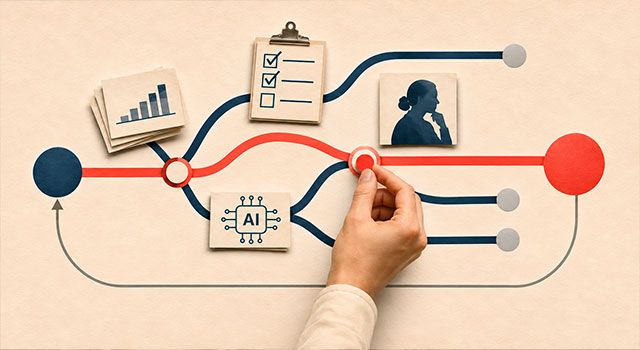
Simply put, robotic process automation (RPA) can be likened to the diligent worker automating repetitive motions. In contrast, intelligent process automation (IPA) transforms this into an orchestra, adding cognitive notes and AI harmonies.
Just as a conductor shapes an ensemble's performance, we'll help you determine which automation symphony resonates best with your organizational goals.
What is robotic process automation (RPA)?
Robotic process automation uses software bots to carry out repetitive, rules-based tasks in digital applications. These tasks typically have defined inputs, actions, and outputs.
Examples include data entry, retrieving records, updating customer information, and completing specific steps in account setup.
RPA works best when the required actions and inputs are sufficiently predictable. A bot can follow configured instructions, but it does not inherently understand ambiguous information or independently decide how to handle an unfamiliar situation.
RPA and artificial intelligence are distinct concepts. AI can add capabilities such as document interpretation or classification, while RPA performs the actions it has been configured to execute.
For the broader relationship between task automation and process-level automation, read RPA vs BPA.
What is intelligent process automation (IPA)?
Intelligent process automation combines AI with workflows, business rules, integrations, and other automation technologies to support business processes.
Depending on the use case, an IPA implementation may include:
Machine learning
Natural language processing
Intelligent document processing
Workflows and business rules
RPA or other system integrations
These capabilities can help teams interpret information, evaluate conditions, and coordinate actions. Not every implementation needs every technology, and RPA is not required when other integration methods are more suitable.
Machine learning uses patterns learned from data to make predictions or classifications.
Supervised learning uses labeled examples, while unsupervised learning identifies patterns without predefined labels. In an automated process, these techniques might help classify requests, identify unusual activity, or prioritize cases for review.
Adding machine learning does not mean a bot automatically evaluates and improves itself. Model updates require an appropriate feedback process, testing, and oversight.
Natural language processing
Natural language processing helps software analyze human language. It can support activities such as categorizing messages, identifying information in text, and determining the subject of a customer request.
NLP is often used in chatbots and other conversational interfaces. Those tools may connect to applications through APIs, integrations, or RPA, but they do not inherently require bots to communicate with users.
Intelligent document processing
Intelligent document processing combines capabilities such as document classification, optical character recognition, and extraction to turn document content into usable information.
For example, it can capture customer details from an onboarding form or invoice information from a submitted document.
Extracted information still needs appropriate checks. Missing, inconsistent, or uncertain values should follow a defined review path rather than automatically moving forward.
Intelligent workflows
Introducing AI and bots into a process creates new handoffs. Teams need to know when an automated action should run, when a person should review an output, and what happens if a step fails.
Workflow automation coordinates these activities. A business rules engine can manage conditions such as approval requirements, routing criteria, and escalation thresholds.
Together, these capabilities make responsibilities and next steps clearer across automated and human work.
IPA vs RPA: what are the key differences?
Handling information
RPA typically works with structured information and predictable instructions.
IPA can add capabilities for interpreting documents, language, and other varied inputs. That interpretation is not guaranteed to be correct, so validation remains important.
Performing actions
RPA focuses on completing configured tasks, such as entering information or retrieving a record.
IPA coordinates information handling, decision logic, and actions within a broader process. A bot may carry out one of those actions.
Responding to change
An RPA bot may need reconfiguration when an application interface or task requirement changes.
AI-enabled processes also require maintenance as data, document types, models, or operating conditions change. IPA does not remove the need for testing and controlled updates.
Managing oversight
RPA needs monitoring for failures, incomplete actions, and application changes.
IPA also needs controls for inaccurate extraction, misclassification, and unsupported outputs. AI governance helps connect those controls to permissions, audit trails, and human review.
The distinction is not simply “RPA follows rules, while IPA thinks.” Both require defined responsibilities, reliable execution, and clear boundaries.
Connect AI and bots through orchestration
IPA and RPA are not mutually exclusive. AI can turn document content into usable information, while a bot performs a defined action using the validated result.
The broader process still needs to coordinate dependencies, approvals, and exceptions.
Universal orchestration brings workflows, systems, people, and AI together so individual automations contribute to a complete business outcome.
The goal is not to add AI to every task. It is to use each capability where it improves the process while preserving appropriate human involvement.
Choose automation based on the work
RPA can reduce repetitive application work. IPA adds capabilities for handling information that requires interpretation, classification, or analysis.
Start with the process requirements, then decide which combination of AI, workflows, business rules, integrations, and bots will help.
Explore the Decisions platform to see how workflows, rules, integrations, AI, and governance support intelligent process automation.
Frequently Asked Questions
What is the difference between IPA and RPA?+−
RPA uses software bots to perform defined tasks. IPA combines AI with workflows, rules, integrations, and other automation technologies to support work that may require interpretation or classification. RPA can be one component of an IPA implementation.
Can IPA and RPA work together?+−
Yes. AI can extract or classify information, rules can validate it, and a bot can perform an authorized application task. A workflow coordinates those steps and routes exceptions for review.
Does intelligent process automation learn automatically?+−
Not by default. An IPA implementation may use trained models, but that does not mean it learns from every completed task. Model changes require suitable data, evaluation, and controlled deployment.
Intelligent Process Orchestration: Connecting AI, Automation, and People