What is process mining? How it compares to process discovery, task mining, and process intelligence.
Key takeaways:
Process mining uses event logs from enterprise systems to rebuild how a process really runs, then compares it to the ideal process to find bottlenecks and deviations.
Task mining and process discovery capture desktop work that event logs miss, such as steps in spreadsheets and email.
Process intelligence combines process mining and task mining for a complete view of how work gets done.
Process mining is a technique for discovering, monitoring, and improving business processes using data from the event logs in enterprise systems. It rebuilds how a process actually runs, compares it to how it should run, and shows where bottlenecks and deviations happen.
Process mining is often confused with process discovery, task mining, and process intelligence. All four help organizations uncover how work really gets done, which makes them a common first step in process automation. But they collect different data and answer different questions. This guide explains what process mining is, how it works, and how it compares to the other three.
[@portabletext/react] Unknown block type "imageWithAlt", specify a component for it in the `components.types` prop
How process mining works.
Process mining usually runs in three stages:
Process discovery: building a model of the as-is process from event log data.
Conformance checking: comparing the as-is process to the desired process to find deviations.
Enhancement: using what you learned to improve the process, then monitoring the results.
Before analysis begins, the data is collected, cleaned, and structured. Analysts then focus on key performance indicators, such as cycle time and the cost of each step, to pinpoint bottlenecks and recommend improvements. Unlike , which looks for patterns in any dataset, process mining follows the sequence of events that make up a process.
Process mining gives teams facts instead of assumptions about how work flows. See how process mining works in Decisions, or read on for what it helps organizations do:
Reveal inefficiencies and hidden process variants.
Measure the time and cost of each process step.
Support compliance by detecting deviations from policy.
Test changes with what-if simulation before they go live.
Start automation initiatives from data rather than guesswork.
Process mining use cases.
Process mining works across industries and departments, and it's especially valuable for organizations with complex processes and high volumes of data. Some of the most common use cases are:
Auditing and compliance.
Order management.
Purchase-to-pay.
Order-to-cash.
Lead-to-order.
Logistics.
In insurance, for example, process intelligence helped one underwriting team identify its key improvement areas by combining process and task data.
Process discovery 101
Get the guide to how process discovery uncovers the way work really gets done, and how to use it as a starting point for automation.
The term process discovery is used in two ways. In process mining, it's the first stage: building the as-is model from event logs. In automation, it also refers to tools that monitor and capture user interactions across applications, using techniques such as machine learning and computer vision to map how processes are actually executed. This second kind of process discovery is often offered by robotic process automation (RPA) vendors to uncover automation opportunities.
Process mining vs. process discovery.
Process mining shows what happened in your systems. Process discovery adds the human element by focusing on how people interact with those systems. Say Tom submits a purchase order for office supplies, entering the vendor, products, prices, and payment terms. Process mining captures the order's events in the system, while process discovery captures Tom's interactions to add context.
Process discovery also doesn't need integration with back-end systems. A virtual agent on the user's desktop records keystrokes and mouse clicks, then combines them with context recognition to show how tasks are performed and where they vary.
What is task mining?
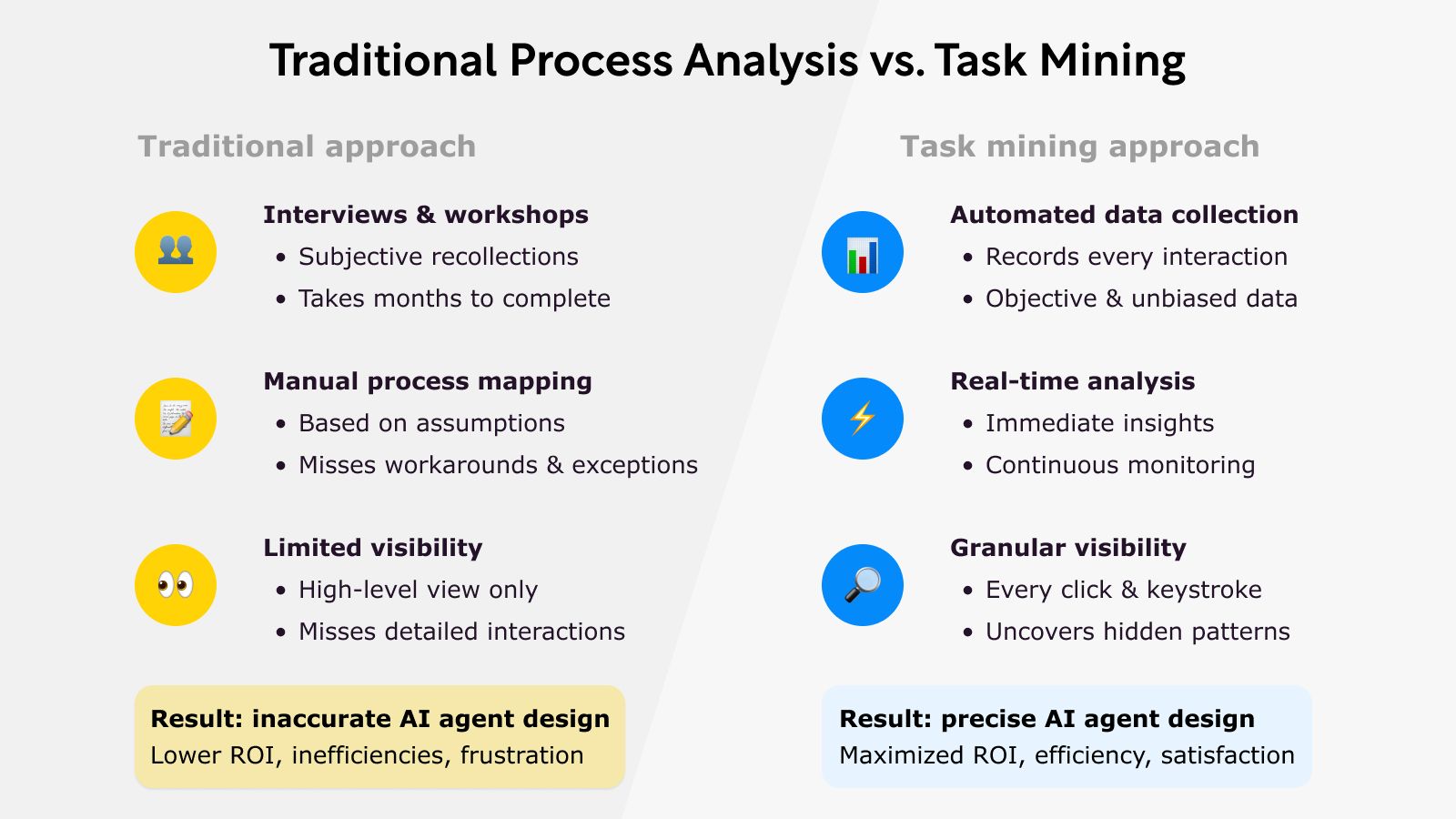
Task mining analyzes how individual tasks are performed on desktops. Like process discovery, it tracks users' digital footprints, using character recognition, natural language processing, and other analytics to study clicks and keystrokes and find patterns worth improving. It focuses on the small units of work inside a process, such as copying and pasting data or uploading and downloading files.
Typical task mining use cases include data entry, invoicing, reporting, and reconciliation.
Process mining vs. task mining.
A process is a logical sequence of events with a defined start and end, such as purchase-to-pay, which spans several teams. Tasks are the smaller pieces of work that happen within and between processes. Process mining covers the end-to-end flow, and task mining covers the detail inside it.
The two work best together. Some applications don't generate event logs, which limits process mining. If an invoicing specialist works in an e-invoicing platform and also in Excel, process mining sees only the platform steps and misses the work in Excel. Task mining fills those gaps by capturing activity in email, spreadsheets, and other productivity tools.
Process discovery vs. task mining.
Process discovery and task mining both track desktop activity with similar technology, so the terms are often used interchangeably. The difference is purpose: task mining focuses on finding inefficiencies in tasks, while process discovery uses the same data to identify automation opportunities. Process mining vendors typically offer task mining alongside their tools, while RPA vendors focus on process discovery.
Process intelligence vs. process mining.
Process intelligence is a comprehensive approach to understanding and optimizing business processes with data and analytics. Process mining is a subset of it that focuses on event logs from systems such as ERP and CRM applications. Think of process intelligence as the umbrella that brings process mining, task mining, and other process analytics together, and connects them to the practical work of improving processes.
The two differ in four main ways:
Scope: process intelligence covers a broad range of processes across the organization, while process mining focuses on specific processes captured in event logs.
Data sources: process intelligence draws on a wider variety of structured and unstructured data, while process mining relies mainly on event logs.
Approach: process intelligence spans discovery, monitoring, optimization, and automation, while process mining focuses mainly on discovery and analysis.
Capabilities: process intelligence adds real-time monitoring, workflow automation, and advanced analytics, while process mining specializes in finding inefficiencies and bottlenecks in event logs.
Why combine process mining and task mining.
Combining process mining and task mining in one process intelligence strategy gives you a fuller picture than either one alone:
Detailed process understanding: task mining shows individual user interactions, and process mining shows the end-to-end flow, so you see your processes at both the macro and micro level.
Root cause identification: together, they pinpoint bottlenecks and inefficiencies at both the task and process level, so improvement decisions are based on data.
Processes linked to work patterns: finding repetitive, time-consuming tasks makes it easier to streamline or automate them, which frees people for more valuable work.
Faster discovery: task mining captures user interactions automatically, which shortens the time it takes to map and understand processes.
Continuous improvement: combined monitoring helps you catch new issues early and keep improving over time.
Limitations of each approach.
Process mining is limited to the steps recorded in designated IT systems, so it misses the human element and work done in other applications, such as spreadsheets and documents.
Process discovery and task mining add that human perspective, but they're most effective for shorter, simpler tasks. For long processes, their computation-heavy analysis can return inaccurate results and lose sight of how a task fits into the bigger picture.
Which approach is right for you?
The right choice depends on your processes and goals:
Process mining suits complex, system-heavy processes in ERP, CRM, and supply chain systems, where it aligns separate processes with broader business goals.
Task mining suits processes that span many applications, where the small steps between major activities matter.
Process discovery suits teams replacing manual discovery methods who want to find automation opportunities faster.
Process intelligence suits organizations that want all of the above in one view, along with real-time monitoring and a path to automation.
Close the gap with process intelligence.
Decisions process intelligence combines process mining and task mining in one platform, so you can see what happens inside your systems and what happens between them. Map processes, find root causes, simulate changes, and move straight from discovery to automation on the same process intelligence platform.
Process mining is a technique for discovering, monitoring, and improving business processes using event log data from enterprise systems. It rebuilds the as-is process, compares it to the desired process, and shows where bottlenecks, deviations, and improvement opportunities are.
What are the three stages of process mining?+−
The three stages are process discovery, conformance checking, and enhancement. Discovery builds a model of the as-is process from event logs. Conformance checking compares it to the desired process to find deviations. Enhancement uses those findings to improve the process and monitor the results.
What is the difference between process mining and process discovery?+−
Process mining analyzes event logs to show what happened in your systems. Process discovery tools capture user interactions on desktops to show how people actually carry out processes. In process mining itself, process discovery is also the name of the first stage, where the as-is model is built.
What is the difference between process intelligence and process mining?+−
Process mining is a subset of process intelligence. Process mining analyzes event logs from specific systems, while process intelligence combines process mining, task mining, and other analytics across the organization, adding real-time monitoring, workflow automation, and a path from insight to action.
What are examples of process mining?+−
Common examples include auditing and compliance, order management, purchase-to-pay, order-to-cash, lead-to-order, and logistics. Process mining is especially valuable for organizations with complex processes and high volumes of data, where it shows how processes really run and where they slow down.